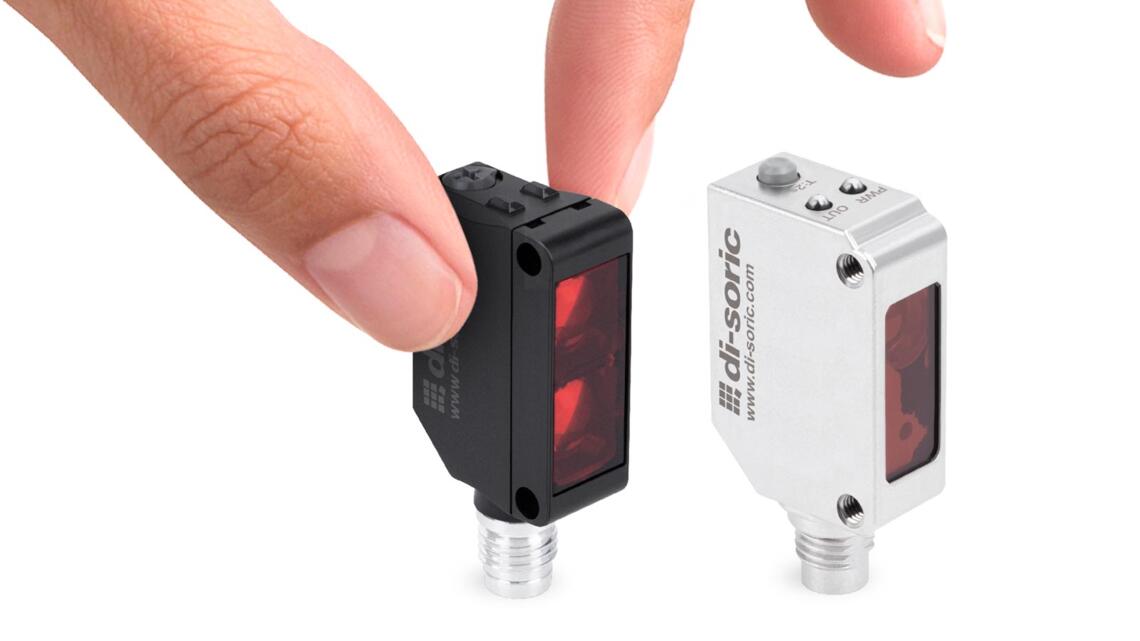
With our versatile functionality, high degree of flexibility and IO-link based application reliability, the innovative sensors from the Urbach automation company are used in particular in the areas of assembly and handling technology, part feeding and in the packaging industry. With the proven di-soric plug & play principle, the sensors are ready to start in no time and operated intuitively without complicated adjustment tasks.
With two complete series and 36 device variants, di-soric covers the field for nearly all optical detection tasks. With hole spacing of 25.4 mm and housing dimensions of 30 mm x 20 mm x 11 mm, the compact sensors take up very little space. Devices from the O-33 Universal series in the plastic housing compliant with IP67 are the ideal choice for many industrial applications. If the mechanical loads are high or aggressive fluids are at play, the robust sensors of the O-34 series are used, which are resistant to cleaning agents according to ECOLAB in the V4A stainless steel housing compliant with IP69K.
Depending on the task, users can select appropriate sensors from four functional principles and the required range. The background suppression sensors from the OH-33 and OH-34 series cover distances of up to 1,000 mm. Depending on requirements, they use red light laser or LED light sources with ultrafine, medium or large light spots. Classic retroreflective diffuse sensors from the OT-33/OT-34 series bridge distances of up to 1,000 mm with LED red light. Retroreflective sensors from the OR-33 and OR-34 series are used at distances up to 6,000 mm. Through-beam sensors achieve process-reliable ranges up to 15,000 mm.
OH33/34-LR laser background suppression sensors, with a range of up to 600 mm, are unique and currently the smallest triangulation sensors on the market. With the teach button, distances, as well as switching windows and DD mode, can be taught in directly at the sensor at the push of a button. DD mode simultaneously evaluates distance and intensity and detects practically all objects according after teach-in against the taught-in background. Without a doubt, this is a performance feature that was previously reserved exclusively for larger sensors.
All sensors can be used out of the box and are already ready for numerous applications with their factory settings. Users can perform the commissioning via button/potentiometer directly at the sensor or via IO-Link from the central operating panel. It is also possible to configure the device directly at the sensor via the 1-point teach with supporting flashing sequence. IO-Link places numerous diagnostic functions at the disposal of users. The digital communication standard offers available measuring functions loss-free through digital data transmission: so, for example, the reproducible setting of switching points and the reliable assessment of functional reliability through simultaneous observation of the measured values and switching point. These can be set in mm or as an intensity value. IO-link therefore offers users the greatest possible flexibility and application reliability.
Users can find more information, application examples, and selectors at
https://www.di-soric.com/int-en/innovations/o33-o34.
Image 1: Optical sensors from the O-33/O-34 series: With two complete series (stable plastic or robust stainless steel housing) and 36 device variants, di-soric covers the field for nearly all optical detection tasks.